If you have an unpaid debt sitting in the back of your mind, you may have wondered whether it eventually disappears on its own. It is a common question – and one surrounded by significant misinformation.
Do unpaid debts go away after enough time passes? The short answer is: not exactly.
Time does change certain aspects of a debt’s status, but it rarely eliminates the underlying financial obligation entirely. Understanding the difference between a debt changing status and a debt disappearing is essential before you decide how – or whether – to act.
This article explains what actually happens to unpaid debt over time, how statutes of limitations work, what credit reporting has to do with it, how laws vary depending on where you live, and what steps you can take to approach your situation with clarity and confidence.
Do Unpaid Debts Go Away Over Time?
Unpaid debts do not simply vanish. Over time, certain things about a debt do change – its enforceability through the courts, its visibility on your credit report, and the nature of collection activity around it. However, the debt itself, as a financial obligation, generally persists regardless of how much time has passed.
What many people are really asking when they wonder whether debt goes away is one of two things:
- Whether a debt can still be legally enforced
- Whether it will continue to appear on their credit report
These are two separate questions with two separate answers – and conflating them is the source of much of the confusion around this topic. The sections below address each one clearly.
What Happens to Unpaid Debt Over Time
When a debt goes unpaid, it does not simply sit still. It moves through a process that typically begins with the original creditor and can involve multiple stages of account management.
Initially, an unpaid account is handled internally by the creditor – the bank, healthcare provider, utility company, or other organization you originally owed. After a period of non-payment, the account may be transferred or sold to a third-party collection agency. This is a routine part of the debt resolution process and does not indicate anything fraudulent or unusual. It simply means the original creditor has chosen to transfer responsibility for recovering the balance.
Once an account reaches a collection agency, the agency will typically attempt to contact the consumer to discuss the account and explore resolution options. The debt continues to exist and remains a financial obligation throughout this entire process. The passage of time alone does not erase it.
If you have received a notice from a collection agency about an account you do not recognize, our blog on Why You Might Not Recognize a Debt and What to Do Next explains the most common reasons why this happens.
What Is the Statute of Limitations on Debt
The statute of limitations on debt refers to the window of time during which a creditor or collection agency can sue you in court to legally enforce repayment. Once that window closes, the debt may no longer be legally enforceable through litigation – but it does not cease to exist as a financial obligation.
What happens when the statute of limitations expires
Once a debt becomes time-barred, a collector generally loses the ability to file a successful lawsuit to compel repayment. If legal action were pursued on a time-barred debt, the consumer could raise the expiration as a legal defense, and courts will often dismiss such claims.
However, in many states, collectors may still contact consumers and request voluntary repayment after the statute of limitations has passed – provided they operate within the boundaries set by applicable law.
State-level restrictions on time-barred debt
While federal law under the Fair Debt Collection Practices Act (FDCPA) sets out baseline consumer protections, individual states can and do go further. Some states require collectors to clearly disclose that a debt is time-barred, and that no lawsuit can be filed to enforce it.
Others go further still – treating any collection activity on a time-barred debt, including written or verbal contact, as a violation of state consumer protection law. Because these rules vary significantly from one state to another, it is important to verify which laws apply to your specific situation. What is a permissible collection activity in one state may constitute a legal violation in another.
Cease and desist: your right to stop contact
Regardless of whether a debt is within or past its statute of limitations, consumers have a federally protected right to request that a collection agency stop contacting them through a written cease and desist request.
Under the Fair Debt Collection Practices Act (FDCPA), once an agency receives this in writing, it is generally required to stop all contact – with limited exceptions, such as confirming that contact will cease or notifying the consumer of a specific intended action.
It is important to understand that a cease and desist request stops communication – it does not eliminate the debt or prevent a collector from pursuing other available legal remedies if the debt is still within the statute of limitations. To be effective, the request must be submitted in writing and sent via a method that provides proof of delivery. A verbal request does not carry the same legal weight.
What collectors can still do after the statute of limitations expires
A time-barred debt limits a collector’s legal remedies but does not leave them without options. Depending on the jurisdiction, collectors may still report the debt to credit bureaus within the applicable credit reporting window, contact consumers to request voluntary repayment where state law permits and proper disclosures are made, offer settlement or resolution arrangements on a voluntary basis, or sell and transfer the account to another agency.
What collectors cannot do is use deceptive or misleading practices – including threatening legal action they cannot take, misrepresenting the debt’s status, or failing to make required disclosures about the statute of limitations having expired.
What it all comes down to
The statute of limitations that applies to your debt depends on the type of debt, where you lived when it was incurred, your current location, and in some jurisdictions, whether you have made any payments or acknowledgments since the debt went unpaid, as certain actions can restart the clock. Because of this complexity, it is important to verify your specific situation rather than rely on general timelines.
Does Debt Disappear After a Certain Number of Years
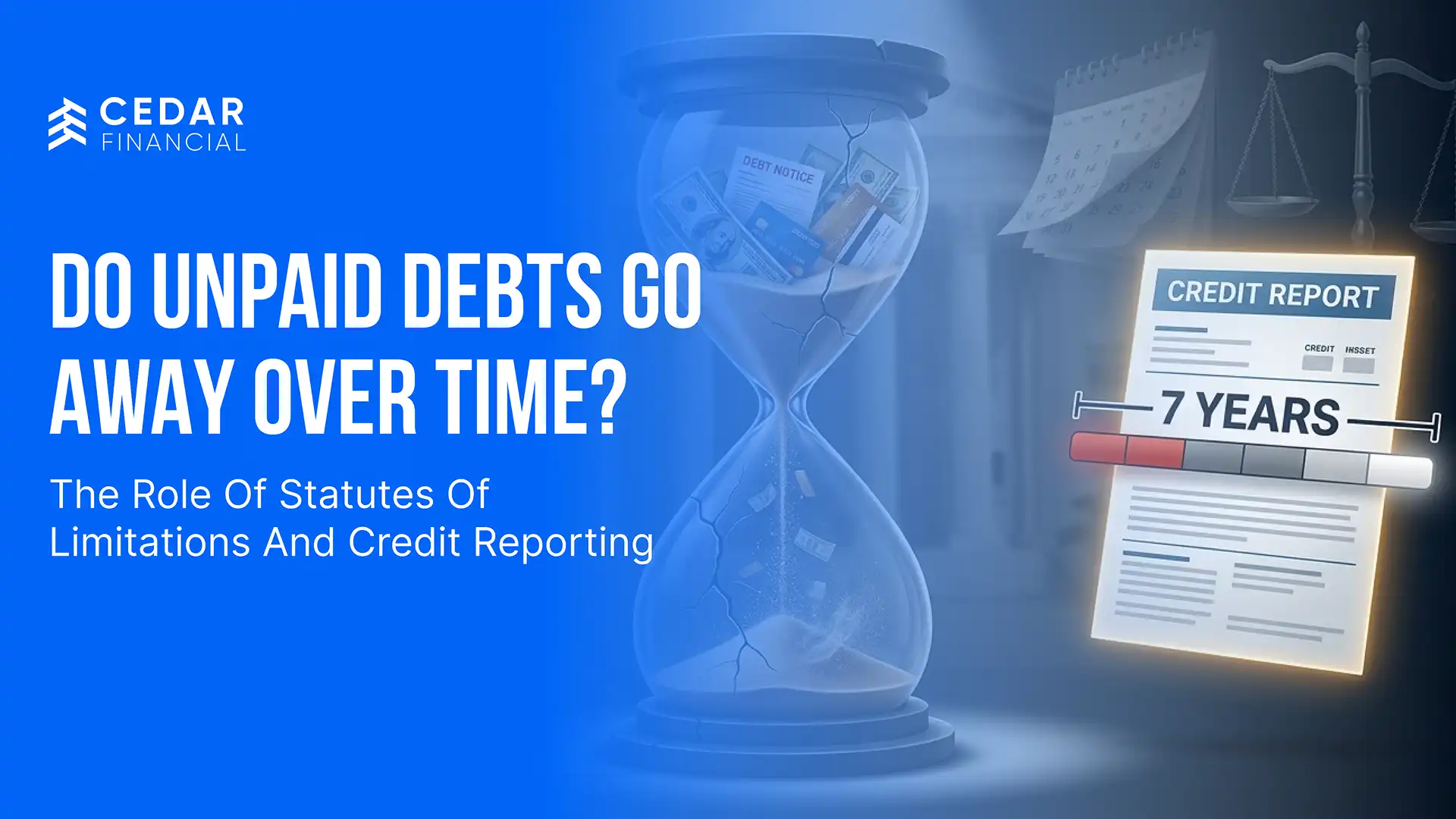
This section addresses one of the most persistent debt collection myths: the idea that debt automatically disappears after seven years.
The seven-year figure comes from credit reporting rules, not from any law that eliminates debt itself. Under general credit reporting guidelines, most negative items – including collection accounts and late payments – are removed from a consumer’s credit report after a certain number of years. This is a credit reporting timeline, not a debt expiration date.
The critical distinction is this: a debt being removed from your credit report is not the same as the debt no longer existing.
The financial obligation may still be valid even after it no longer appears on your credit file. A collection agency may still hold the account, and depending on the jurisdiction and type of debt, it may still be within the statute of limitations for legal enforcement.
Acting on the assumption that unpaid debt disappears after seven years – without verifying your specific situation – can lead to unexpected consequences. For more on common misconceptions like this one, read: Common Myths About Debt Collection Agencies and the Truth Behind Them.
How Debt Laws Can Vary by State or Country
There is no single universal rule that governs how long a debt can be collected, when it becomes legally unenforceable, or how long it appears on a credit report. These rules vary depending on jurisdiction – meaning the state, country, or region where the debt originated or where you currently live.
In the United States, statutes of limitations differ from state to state and can also differ based on the type of debt involved – credit card debt, medical debt, personal loans, and written contracts may each be treated differently under local law. Outside the United States, the rules vary even more significantly from one country to another.
This means that general statements about debt timelines – including many of the figures that circulate online – may not reflect your actual legal situation. The most reliable approach is to seek verified information about the rules that apply specifically to your location and your type of debt, rather than basing decisions on general timelines that may not be relevant to you.
Can Debt Collectors Still Contact You After Many Years
Yes – in many cases, a collection agency may still contact you about a debt even after a significant amount of time has passed. The passage of time does not automatically end communication around an account, even if the statute of limitations for legal enforcement has expired, and is subject to the state-specific restrictions outlined above.
Your consumer rights remain fully in place regardless of how old the debt is. Under the Fair Debt Collection Practices Act and applicable state laws, collectors must operate within defined boundaries at all times – including restrictions on when and how often they can contact you, prohibitions on harassment or deceptive language, and your right to request debt validation in writing.
If you have received contact about an old account and are unsure whether it is legitimate, read more on “Is Cedars Business Services a Scam?” – which explains how to distinguish between a licensed collection agency and a fraudulent caller. You can also review our guide on Real Cedar vs. Fake Cedar for specific verification steps.
Why Ignoring Unpaid Debt May Not Be the Best Approach
It is understandable to want to avoid thinking about an unpaid debt, particularly one that has been lingering for a long time. But ignoring the situation rarely makes it better – and in some cases, it can narrow your options for resolving it on favorable terms.
Some of the risks associated with ignoring old or unpaid debt include:
- Continued collection activity, including phone calls and written notices
- Potential impact on your credit report, depending on the age of the account
- Legal action, if the debt remains within the statute of limitations for your jurisdiction
- Missed opportunities to negotiate a resolution or clarify a dispute before the situation escalates
The point is not to alarm you – it is to highlight that avoidance tends to reduce your options, while engagement tends to expand them. Understanding your situation is always better than assuming it will resolve itself.
What You Should Do If You Have an Old or Unpaid Debt
If you have an old or unpaid debt – whether you are actively receiving collection notices or simply aware that an account has gone unresolved – the following steps provide a practical starting point:
1. Verify the debt
Request written validation of the account before taking any other action. You are entitled to documentation confirming the debt’s origin, current balance, and the identity of the agency holding it.
2. Ask questions
Contact the collection agency for clarification. A legitimate agency will answer your questions clearly and provide the information you need to understand the account.
3. Understand your rights
Familiarize yourself with your consumer rights under applicable federal and state law, including your right to dispute the debt and your right to request that contact cease.
4. Consider your options
Depending on the age of the debt, its current status, and your financial situation, there may be several paths forward – including voluntary resolution, a formal dispute, or a written cease and desist if contact is unwanted.
5. Take informed action
Whether you choose to dispute the debt, arrange a resolution, or seek further guidance, do so from a position of verified information – not assumption or avoidance.
For questions specific to an account held by Cedars Business Services, you can reach them directly by phone to discuss the details of your situation.
How Cedar Financial and Cedars Business Services Handle Older Accounts
Cedar Financial and Cedars Business Services serve distinct roles within the debt resolution process, and that distinction matters when understanding how older accounts are handled.
Cedar Financial is a business-facing agency. It works on the creditor side – partnering with organizations to manage receivables and ensure accounts are handled accurately and in compliance with applicable regulations. Cedar Financial does not contact consumers directly. Its role is operational and creditor-focused.
Cedars Business Services is the consumer-facing collection entity. If you have received a call, letter, or notice, it is Cedars Business Services that has reached out to you – including outreach related to older accounts that may have been dormant for some time.
Cedars Business Services operates under the Fair Debt Collection Practices Act (FDCPA) and all applicable state laws, and its approach to every account, regardless of age, is built around transparency, accuracy, and respect for consumer rights.
When Cedars Business Services contacts a consumer about an older account, the goal is not to pressure them. It is to provide the consumer with the information they need to understand the account and make an informed decision. Consumers are always encouraged to ask questions, request documentation, and take the time they need to verify the details before deciding on next steps.
If you have received communication from Cedars Business Services and want more information, you can contact them directly by phone. You can also read our blog on “Why Am I Being Contacted by Cedars Business Services?” for additional context.
Frequently Asked Questions
Do unpaid debts go away after 7 years?
Not exactly. The seven–year figure refers to how long most negative items can remain on a credit report under general credit reporting guidelines – not to the existence of the debt itself. A debt may be removed from your credit report after a certain period while still existing as a financial obligation. Whether it remains legally enforceable depends on the statute of limitations applicable to your specific jurisdiction and type of debt.
Does debt ever expire completely?
Debt does not expire in the way many people assume. While statutes of limitations affect whether a debt can be enforced through the courts, those limits vary by jurisdiction and type of debt, and they do not eliminate the underlying financial obligation. Some states also restrict or prohibit collection activity on time–barred debts entirely, while others permit voluntary collection efforts to continue. Verifying the rules that apply to your specific situation is always the recommended approach.
Can a debt be too old to collect?
The statute of limitations determines the window during which a collector can take legal action to enforce repayment. Once that window closes, legal enforcement through the courts may no longer be an option – though this varies by jurisdiction and debt type. In some states, any collection activity on a time–barred debt is prohibited. In others, voluntary collection contact may continue with appropriate disclosures. Verifying your specific situation is always the recommended first step.
Can debt collectors contact me after many years?
In many cases, yes – though this depends on your state’s laws. Some states restrict or prohibit contact on debts past their statute of limitations. In states where contact is permitted, your consumer rights remain fully intact. You are entitled to request written validation of any debt, and you may submit a written cease and desist request to stop further contact, regardless of the debt’s age.
Does unpaid debt affect my credit score over time?
Unpaid debt can affect your credit report for a period of time, after which most negative items are generally removed under credit reporting guidelines. However, removal from a credit report does not mean the debt no longer exists. The impact on your credit score will depend on the specific account, its current status, and the reporting practices of the agencies involved.
Do debt laws differ by state or country?
Yes, significantly. Statutes of limitations, credit reporting timelines, consumer protection rules, and restrictions on collecting time–barred debts all vary depending on where you live and where the debt originated. What is permissible in one state may be prohibited in another. Always verify which rules apply to your specific situation rather than relying on general information that may not be relevant to you.